Personality-targeted Interventions Can Reduce Alcohol and Marijuana Use Among Adolescents

Cover-Photo-for-Conrod-post

Let me state the obvious: alcohol and marijuana are the two most widely used drugs of abuse in the United States. According to the annual National Survey on Drug Use and Health (NSDUH), (the most comprehensive survey of drug use and abuse in the United States conducted by the Substance Abuse and Mental Health Services Administration (SAMHSA)) as of 2013, 86.8% of the population aged 18 or older have reported having consumed alcohol during their lifetime with over 16.6 million adults diagnosed with alcohol abuse disorder.

Of course, we all know the prevalence and extent of underage drinking, and the damage alcohol has on the developing brain has been heavily researched, not to mention all the significant secondary problems associated with alcohol abuse (car crashes, sexual assault on college campuses, falling off of balconies… ).

But here’s some numbers anyways: as of 2013, 8.7 million youths aged 12-20 reported past month alcohol use, a shockingly high number for an age group this is not legally allowed to drink alcohol…

Similarly, marijuana, which is still illegal in the vast majority of the US, is nearly as ubiquitous. According to the NSDUH 2013 survey, 19.8 million adults aged 18 or older reported past month marijuana use.

And with marijuana legalization in Colorado and Washington, a significant concern raised by many is that abuse of the drug among youths will dramatically increase even higher than it is now. The research supporting the damage marijuana can inflict on brain development is also significant.

But what if the risk of use of alcohol and marijuana by youths could be reduced? What if a teacher could be given the tools to not only identify certain risky personality traits in their students but also use that knowledge to help those at-risk students from trying and using drugs such as alcohol and marijuana? A series of studies coming out of the laboratory of Dr. Patricia A Conrod of King’s College London report having done exactly that.
SFN 2015 LogoI had the pleasure of seeing Dr. Conrod speak at the recent Society for Neuroscience Conference as part of a satellite meeting jointly organized by the National Institute on Drug Abuse (NIDA) and National Institute on Alcohol Abuse and Alcoholism (NIAAA). Dr. Conrod presented a compelling story spanning over a decade of her and her colleague’s work, in which certain personality traits amongst high risk youths, can actually be used to predict drug abuse amongst those kids. Dr. Conrod argues that by identifying different risk factors in different adolescents, a specific behavioral intervention can be designed to help reduce alcohol drinking and marijuana use in these youths. And who is best to administer such an intervention? Teachers and counselors, of course: educators that spend a great deal of time interacting with students and are in the best position to help them.

The Teacher-Delivered Personality Targeted Interventions For Substance Misuse Trial, also known as the Adventure Trial, was conducted in London during 2008-2009 and the results were first published in 2010.

This ambitious study recruited 2,643 students (between 13 and 14 years old) from 21 secondary schools in London (20 of the 21 schools were state-funded schools). Importantly, this study was a cluster-randomized control trial, which means the schools were randomly assigned to two groups: one group received the intervention while the other did not. The researchers identified four personality traits in high-risk (HR) youths that increase the risk of engaging in substance abuse. The four traits are:

  1. Anxiety sensitivity,
  2. Hopelessness
  3. Impulsivity
  4. Sensation seeking.

A specific intervention based on cognitive behavioral therapy (CBT) and motivational enhancement therapy (MET) was developed to target each of these personality traits. Teacher, mentors, counselors, and educational specialists in each school that were recruited for the study were trained in the specific interventions. In general, CBT is an approach used in psychotherapy to change negative or harmful thoughts or the patient’s relationship to these thoughts, which in turn can change the patient’s behavior. CBT has been effective in a treating a number of mental disorders such anxiety, personality disorders, and depression. MET is an approach used to augment a patient’s motivation in achieving a goal and has mostly been employed in treating alcohol abuse.

The CBT and MET interventions in this study were designed to target one of the four personality traits (for example, anxiety reduction) and were administered in two 90-minute group sessions. The specific lesson plans for these interventions were not reported in the studies but included workbooks and such activities as goal-setting exercises and CBT therapies to help students to dissect their own personal experiences through identifying and dealing with negative/harmful thoughts and how those thoughts can result in negative behaviors. Interestingly, alcohol and drug use were only a minor focus of the interventions.

The success of the interventions was determined through self-reporting. The student’s completed the Reckless Behavior Questionnaire (RBQ), which is based on a six-point scale (“never” to “daily or almost daily”) to report substance use. Obviously due to the sensitive nature of these questionnaires and need for honesty by the students, measures were taken to ensure accuracy in the self-reporting, such as strong emphasis on the anonymity and confidentiality of the reports and inclusion of several “sham” items designed to gauge accuracy of reporting over time. Surveys were completed every 6-months for 24-months (two years) which is a sufficient time frame to assess the effect of the interventions.

Most importantly, schools were blinded to which group they were placed in and teachers and students not involved in the study were not aware of the trial occurring at the school. The students involved were unaware of the real purpose and scope of the study. These factors are important to consider because it held eliminate secondary effects and helps support the direct efficacy of the interventions themselves.

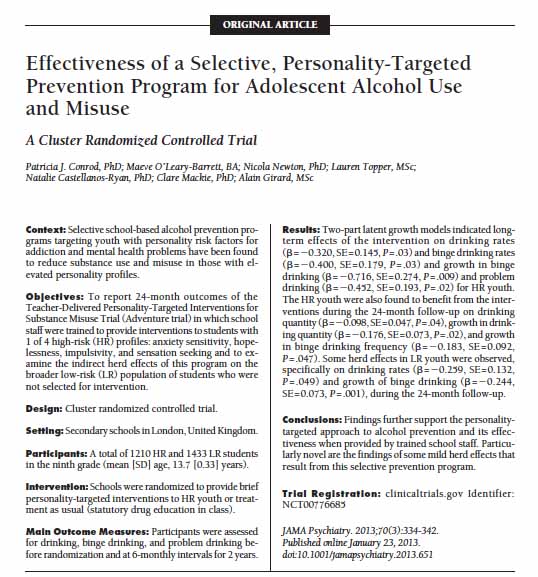
The results were impressive: reduced frequency and quantity of drinking occurred in the high-risk students that received the intervention compared to the control students that did not. While HR students were overall more likely to report drinking than low-risk (LR) students, the HR students saw a significant effect of the personality-targeted interventions on drinking behavior.
Conrod et al.2013 abstract

A study of this size is incredibly complex and the statistics involved are equally complex. The author’s analyzed the data in a number of ways and published the results in several papers. A recent study modeled the data over time (the 24-months in which the surveys were collected) and used these models to predict the odds that the students would engage in risky drinking behavior. The authors reported a 29% reduction in odds of frequency of drinking by HR students receiving the interventions and a 43% reduction in odds of binge drinking  when compared to HR students not receiving the interventions.

Interestingly, the authors report a mild herd-effect in the LR students. Meaning that they believe the intervention slowed the onset of drinking in the LR students possibly due to the interactions between the HR student’s receiving the interventions and LR students. However, additional studies will need to be done in order to confirm this result.

Recall that the Reckless Behavior Questionnaire (RBQ) was utilized in this study to quantify drug-taking behavior. While the study was specifically designed to measure effects on alcohol, the RBQ also included questions about marijuana. So the authors reanalyzed their data and specifically looked at effects of the interventions on marijuana use.

Mahu et al. 2015

The found that the sensation seeking personality sub-type of HR students that received an intervention had a 75% reduction in marijuana use compared to the sensation seeking HR students that did not receive the intervention. However, unlike the findings found on alcohol use, the study was not able to detect any effect on marijuana use for the HR students in general. Nevertheless, the data suggest that the teacher/counselor administered interventions are effective at reduce marijuana use as well.

While you may be unconvinced by the modest reduction in drinking and marijuana frequency reported in these studies and may be skeptical of the long-term effect on drug use in these kids, keep in mind that the teachers and counselors that administered these interventions received only 2 or 3 days of training and the interventions themselves were very brief, only two 90-minute sessions. What I find remarkable is that such a brief, targeted program can have ANY effects at all. And most importantly, the effects well outlasted the course of the interventions for the full two-years of the follow-up interviews.

These targeted interventions have four main advantages:

  1. Administered in a real-world setting by teachers and counselors
  2. Brief (only two 90-minute group sessions)
  3. Cheap (the cost of training and materials for the group sessions)
  4. Effective!

The scope of this intervention needs to be tested on a much larger cohort of students in a larger variety of neighborhoods but it is extremely promising nonetheless. Also, it would be interesting to breakdown these data by race, socioeconomic status, and gender, all of which may impact the effectiveness of the treatments and was not considered in this analysis. Finally, how would you implement these interventions on a wide scale? I eagerly look forward to additional work on these topics.

Thanks for reading 🙂

See these other articles in Time and on King’s College for less detailed discussions of these studies.

Also see these related studies from Conrod’s group:

Castellanos-Ryan N, Conrod PJ, Vester JBK, Strain E,, Galanter M, Conrod PJ. Personality and substance misuse: evidence for a four-factor model of vulnerability. In: Vester JBK, Strain E, Galanter M, Conrod PJ, eds. Drug Abuse and Addiction in Medical Illness. Vols 1 and 2. New York, NY: Humana/Spring Press; 2012.

Conrod PJ, Pihl RO, Stewart SH, Dongier M. Validation of a system of classifying female substance abusers on the basis of personality and motivational risk factors for substance abuse. Psychol Addict Behav. 2000;14(3):243-256.

Conrod PJ, Stewart SH, Comeau N, Maclean AM. Efficacy of cognitive behavioral interventions targeting personality risk factors for youth alcohol misuse. J Clin Child Adolesc Psychol. 2006;35(4):550-563.

Conrod PJ, Castellanos-Ryan N, Strang J. Brief, personality-targeted coping skills interventions and survival as a non-drug user over a 2-year period during adolescence. Arch Gen Psychiatry. 2010;67(1):85-93.

O’Leary-Barrett M, Mackie CJ, Castellanos-Ryan N, Al-Khudhairy N, Conrod PJ. Personality-targeted interventions delay uptake of drinking and decrease risk of alcohol-related problems when delivered by teachers. J AmAcad Child Adol Psychiatry. 2010;49(9):954-963.

Promising Shifts in Policy Towards Addiction Prevention and Treament

Spilled prescription medication --- Image by © Mark Weiss/Corbis

Spilled prescription medication — Image by © Mark Weiss/Corbis


Normally a search for drug addiction in Google news pulls up a similar thread of articles: arrests of dealers and addicts, big drug busts, a crime committed by a user or dealer, somebodies mug shot. Basically, the news tends to cover only the drug enforcement and criminal aspects of the drug addiction problem. This is unsurprising since for the past few decades the lens in which we view addicts and addiction has been smeared by the “War on Drugs”, which views drug users as criminals and deviants and seeks to punish rather than treat. However, with advances in medical technology, advances in neuroscience, cognitive psychology, and a host of related fields, we understand addiction at the neurochemical and physiological level better than we ever have before. A shift in attitude that acknowledges addiction as a medical disease that needs to be treated as such (well established in the scientific community) is finally making its way into public consciousness, and most importantly, public policy.

SFN 2015 LogoI was recently at the 2015 Society for Neuroscience Conference, an enormous gathering of neuroscientist from around the world, held Oct 17-21 in Chicago. The conference hosts an overwhelming number of lectures, symposia, and workshops for scientists to share the latest developments in research in Alzheimer’s, Parkinson’s, stroke, learning and memory, brain development, addiction, and many others neuroscience sub-disciplines. Several special lectures on neuroscience related-topics are also held and I had the pleasure of attending one of these special lectures given by the Honorable Jed S. Rakoff, Senior US District Judge for the Southern District of New York and founding member of the MacArthur Foundation Project on Law and Neuroscience, which researches issues on the intersection of law and neuroscience. Judge Rakoff spoke on how new advances in neuroscience research such as improved neuroimaging technologies and greater understanding into human cognition and decision-making, is changing how the law treats defendants. Significantly, Judge Rakoff spoke frequently about addiction, and he acknowledges what many do, that those arrested for non-violent offenses should be treated, not brutalized. However, he explained that many judge’s hands are tied when it comes to sentencing due to laws in place that set mandatory minimums for drug offenders. Judge Rakoff believes these mandatory minimum laws should be eliminated if progress is to be made toward providing treatment, rather than prison sentences, for drug addicts. It was refreshing to hear this come from such a distinguished judge and I hope it is a bellwether for changes in our legal system.

Of course, laws cannot changes without lawmakers to change them. But we may be seeing the beginning of shift in drug addiction policy for the first time in years.

The epidemic of addiction to prescription opioids and heroin has been making news for months now. I’ve blogged about this epidemic in several posts. One covering a review article describing the epidemic, another sharing an excellent article in the Huffington Post about the epidemic and available treatments for opioid addiction, and most recently, an important report released by the Centers for Disease Control that names opioid addiction as one of the counties top public health crises. Following this latter groundbreaking report by the CDC, policy-makers are finally starting to wake up to the problem.

In a speech in on October 21 in Charleston, West Virginia, one of the areas in the country worst hit by the opioid problem, President Obama held an hour-long public forum in which he promised $133 million dollars to combating the prescription opioid and heroin problem. The President gave about a 15-minute introduction to the event, which entailed some of the most refreshing comments about addiction to ever come from a US President.

Watch the full speech here:

President Obama began by citing shocking statistics stated in the CDC report concerning the surge in deaths due to prescription opioids, “More Americans now die from drug overdoses than from motor vehicle crashes…The majority involve legal prescription drugs.” He went on to talk about heroin as an extension of prescription opioid abuse, “4 out of 5 heroin users start with prescription opioids”.

Of special significance was the shift in language he used to describe addiction and addicts, which contrasts strongly with the “War on Drugs” rhetoric of the previous administration. Obama said, “This is an illness and we have to treat is as such. We have to change our mindset”, which is something that scientists have been arguing for years but is just now being acknowledged by a US President.

Progress towards treating addiction cannot be made unless the biological and medical realities of the illness are understood and addicts are treated as patients rather than criminals. Indeed, stigma towards addicts is one of the biggest hurdles towards reforming public health policy and attitudes towards addiction and President Obama admitted this, “We can’t fight this epidemic without eliminating stigma.”

Some progress has been made under Obama’s watch and he and Health and Human Services Secretary Sylvia Burwell outlined several addiction reforms. One important change already in place is a stipulation of the Affordable Care Act that requires insurance to cover treatment for substance abuse disorders. Secretary Burwell outlined three points at the forum in West Virgina for an “evidence-based strategy” towards addiction prevention and treatment:

  • Point 1: Changing prescribing practices. This is necessary to stem the over prescription of opioids and the dependence to the drugs that develops in some patients as result.
  • Point 2: Expand medication-assisted treatment programs and to make sure patients can have access to treatment and behavioral counseling that can help them.
  • Point 3: Increased access to naloxone. Naloxone counteracts the effects of opioids and should be a standard medication on hand for any first responder that deals with overdoses.

The details about implementing these strategies were not provided though.

However, Obama’s speech may be coming too late, as Dr. Andrew Kolodny, founder of the Phoenix House Treatment facilities in New York, believes. As reported in New York Times, Dr. Kolodyn is disappointed with Obama’s progress and thinks he has waited too long to take action and says that opioid epidemic problem has gotten considerably worse over under Obama’s watch.

I am anxious to see what changes may occur within the last year of Obama’s presidency in respect to the opioid epidemic. However, if more permanent changes are not made in the law, a conservative Republican president could easily over turn any changes made and revert to a failed Reagan-era “War on Drugs” approach.

Important Considerations in Optogenetics Behavioral Experiments

Image credit NSF, Inbal Goshen, Karl Deisseroth.

Image credit NSF, Inbal Goshen, Karl Deisseroth.

The third and final part of my three part guest blog series on Optogenetics has been published on the Addgene blog. Addgene is a nonprofit organization dedicated to making it easier for scientists to share plasmids and I’m thrilled to be able to contribute to their blog! This post covers the running behavioral experiments utilizing optogenetics.

Check it out!

http://blog.addgene.org/important-consideration-in-optogenetics-behavioral-experiments


The Materials Science of Optogenetics Experiments

(blog.addgene.org)

(blog.addgene.org)

The second part of my three part guest blog series on Optogenetics has been published on the Addgene blog. Addgene is a nonprofit organization dedicated to making it easier for scientists to share plasmids and I’m thrilled to be able to contribute to their blog! This post covers the material science aspects of running optogenetic experiments.

Check it out!

http://blog.addgene.org/the-materials-science-of-optogenetics-experiments

Optogenetics on the Addgene Blog: Part 1

(blog.addgene.org)

(blog.addgene.org)

The first part of my three part guest blog series on Optogenetics has been published on the Addgene blog. Addgene is a nonprofit organization dedicated to making it easier for scientists to share plasmids and I’m thrilled to be able to contribute to their blog!

Check it out!

http://blog.addgene.org/a-primer-on-optogenetics-introduction-and-opsin-delivery

The Genetic Link Between Creativity and Psychiatric Disease

(www.wikipedia.org)

(www.wikipedia.org)

The biological sciences are in a golden era: the number of advanced technological tools available coupled with innovations in experimental design has led to an unprecedented and accelerating surge in knowledge (at least as far as the number of papers published is concerned). For the first time in history, we are beginning to ask questions in biology that were previously unanswerable.

No field demonstrates this better than genetics, the study of DNA and our genes. With the advent of high-throughput DNA sequencing, genetic information can be acquired literally from thousands of individuals and even more remarkably, can be analyzed in a meaningful way. Genomics, or the study of the complete set of an organism’s DNA or its genome, directly applies these advances to probe answers to questions that are literally thousands of years old.

A recent study, a collaborative effort from scientists in Iceland, the Netherlands, Sweden, the UK, and the US, is an example of power of genomics and to answer these elusive questions.

Power eet al. Nat. Neursci. 2015. Title

The scientists posed an intriguing question: if you are at risk for a psychiatric disorder, are you more likely to be creative? Is there a link between madness and creativity?

Self-portrait with bandaged ear. Vincent van Gogh, 1889. (wikipedia.org)

Self-portrait with bandaged ear. Vincent van Gogh, 1889. (wikipedia.org)

Aristotle himself once said, “no great genius was without a mixture of insanity” and indeed, the “mad genius” archetype has long pervaded our collective consciousness. But Vincent Van Gogh cutting off his own ear or Beethoven’s erratic fits of rage are compelling stories but can hardly be considered empirical, scientific evidence.

But numerous studies have provided some evidence that suggests a correlation between psychiatric disorders and creativity but never before has an analysis of this magnitude been performed.

Genome-wide association studies (GWAS) take advantage of not only the plethora of human DNA sequencing data but also the computational power to compare it all. Quite literally, the DNA of thousands of individuals is lined up and, using advance computer algorithms, is compared. This comparison helps to reveal if specific changes in DNA, or genetic variants, are more common in individuals with a certain trait. This analysis is especially useful in identifying genetic variants that may be responsible for highly complex diseases that may not be caused by only a single gene or single genetic variant, but are polygenic, or caused by many different genetic variants. Psychiatric diseases are polygenic, thus GWAS is useful in revealing important genetic information about them.

This video features Francis Collins, the former head of the Human Genome Project and current director of the National Institutes of Health (NIH), explaining GWAS studies. The video is 5 years old but the concept is still the same (there’s not many GWAS videos meant for a lay audience).

The authors used data from two huge analyses that previously performed GWAS on individuals with either bipolar disorder or schizophrenia compared to normal controls. Using these prior studies, the author’s generated a polygenic risk score for bipolar disorder and for schizophrenia. This means that based on these enormous data sets, they were able to identify genetic variants that would predict if a normal individual is more likely to develop bipolar disorder or schizophrenia. The author’s then tested their polygenic risk scores on 86,292 individuals from the general population of Iceland and success! The polygenic risk scores did associate with the occurrence of bipolar disorder or schizophrenia.

Next, the scientists tested for an association between the polygenic risk scores and creativity. Of course, creativity is a difficult thing to define scientifically. The authors explain, “a creative person is most often considered one who take novel approaches requiring cognitive processes that are different from prevailing modes of thought.” Translation: they define creativity as someone who often thinks outside the box.

In order to measure creativity, the authors defined creative individuals as “belonging to the national artistic societies of actors, dancers, musicians, and visual artists, and writers.”

The scientists found that the polygenic risk scores for bipolar disorder and schizophrenia each separately associated with creativity while five other types of professions were not associated with the risk scores. An individual at risk for bipolar disorder or schizophrenia is more likely to be in creative profession than someone in a non-creative profession.

 The authors then compared a number of other analyses to see if this effect was due to other factors such as number of years in school or having a university degree but this did not alter the associations with being in a creative field.

Finally, the same type of analysis was done with two other data sets: 18,452 individuals from the Netherlands and 8,893 individuals from Sweden. Creativity was assessed slightly differently. Once again creative profession was used but also data from a Creative Achievement Questionnaire (CAQ), which reported achievements in the creative fields described above, was available for a subset of the individuals.

Once again, the polygenic risk scores associated with being in a creative profession to a similar degree as the Icelandic data set; a similar association was found with the CAQ score.

The authors conclude that the risk for a psychiatric disorder is associated with creativity, which provides concrete scientific evidence for Aristotle’s observation all those years ago.

However, future analyses will have to broaden the definition of creativity beyond just narrowly defined “creative” professions. For example, the design of scientific experiments involves a great deal of creativity but is not considered a creative profession and is therefore not included in these analyses, and a similar argument could be made with other professions. Also, no information about which genetic variants are involved or what their function is was discussed.

Nevertheless, this exciting data is an example of the power that huge genomic data sets can have in answering fascinating questions about the genetic basis of human behavior and complex traits.

For further discussion, read the News and Views article, a scientific discussion of the paper, which talks about potential evolutionary mechanisms to explain these associations.

The Formation of New Memories in the Human Brain

Image of the structure of the mouse Hippocampus (Image courtesy of www.gensat.org).

Image of the structure of the mouse Hippocampus (Image courtesy of http://www.gensat.org).

How are new memories created?

This is a fascinating question in neuroscience and at the very core of what makes us human. After all, our entire concept of ourselves is defined by our memories and without them, are we even ourselves? This is a pretty lofty philosophical discussion… but today we’re only interested in the neuroscience of memory.

In specific, what happens to individual neurons in the human brain when a new memory is created and recalled?

Researchers at the University of California-Los Angeles performed a study in humans that has shed some light on this important question. Published recently in the journal Neuron, the novelty of the study involved recording how many times a neuron would fire during a specially designed memory test. In other words, the scientists were able to monitor what happened to individual neurons in a human being as a new memory was being created!

Title Ison et al. 2015

This article is open access (able to downloaded and distributed for free). The article can be found here or download the pdf.

Before I go into what the researchers found, let’s see how it was done.

The subjects in the study were patients being treated for epilepsy. As part of their clinical diagnosis, they had been implanted with an electrode, a tool used to measure neuronal activity or in other words, the electrode measures how often a neuron fires. The fact these patients already had an electrode inserted into the brain for clinical reasons made it convenient for the researchers to conduct this study.

Left Temporal Lobe (www.wikipedia.org)

Left Temporal Lobe (www.wikipedia.org)

The brain region in which the electrode was implanted is called the medial temporal lobe (MTL). The image to the right is of the left human temporal lobe. The medial region of the temporal lobe is located more towards the center of the brain.

Human Hippocampus (www.wikipedia.org)

Human Hippocampus (www.wikipedia.org)

One specific region of the MTL, the hippocampus, is believed to be the primary brain region where memories are “stored”. Specifically, previous studies in animals and humans have suggested that the MTL and hippocampus are very important to encoding episodic memory. Episodic memory involves memories about specific events or places. In this study, the example of episodic memory being used is remembering seeing a person at a particular place. Another example: the game Simon™ can be considered a test of your brain’s ability to rapidly create and recall short-term episodic memories!

Simon game memory

*Note: Episodic memory is considered one of the main bifurcations of declarative memory, or memories that can be consciously recalled. The other type of declarative memory is semantic memory, which are memories of non-physical/tangible things, like facts.

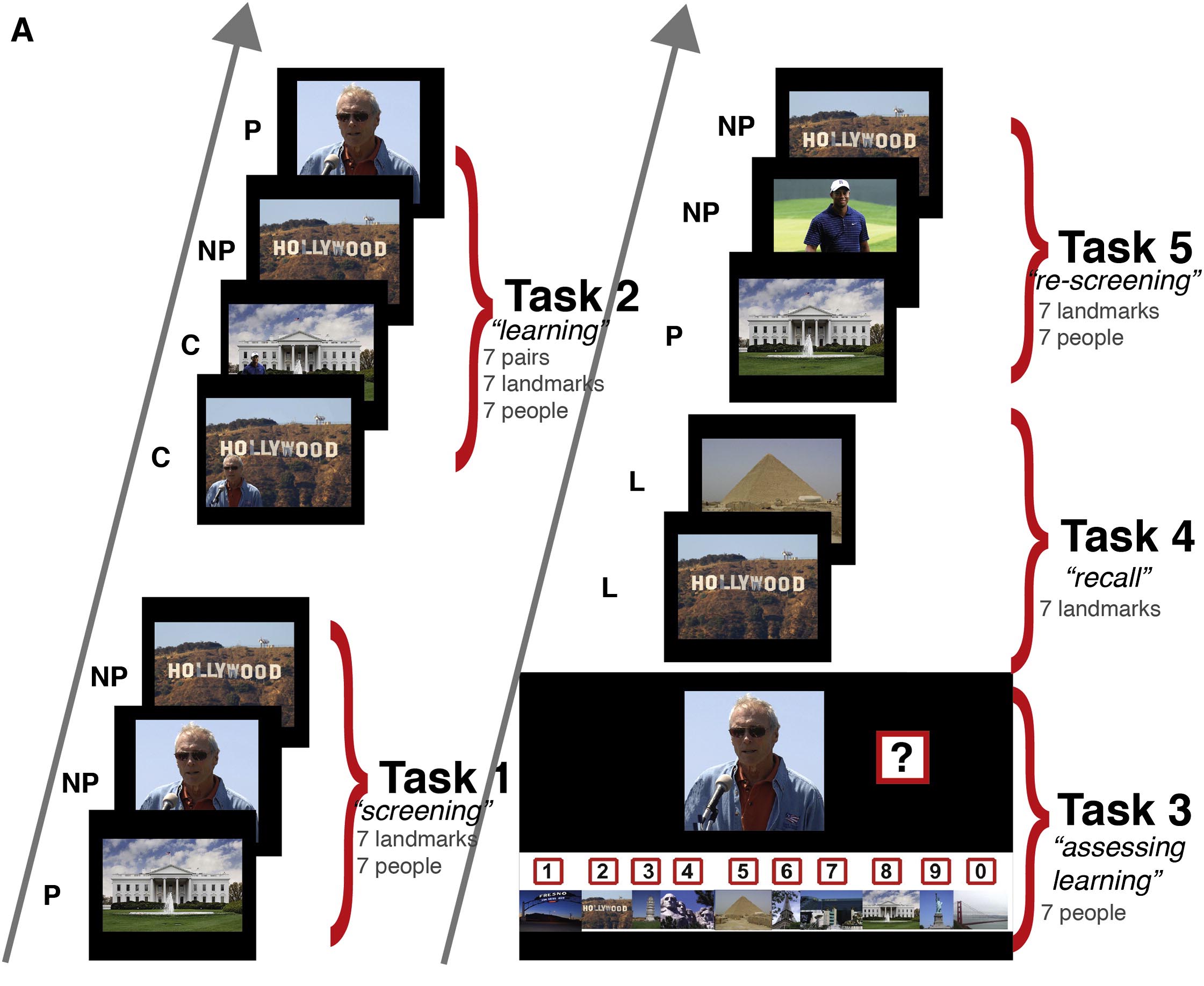
To test the episodic memory of remembering a person at a particular place, images were presented to the patients while the neurons were being recorded. There were 5 different tasks (all completed within 25-30min). See Figure 1 below from the paper.

Figure 1: Experimental Design

Figure 1: Experimental Design

First, a pre-screening was done in which the patients was shown many random images of people and places. The activity of multiple neurons was recorded and the data was quickly analyzed then 3-8 pairs of images were compiled. In each pair, 1 image was “preferred” or “P” image, meaning the neurons being recorded fired when the “P” image was shown. The second image was “non-preferred” or “NP” image, meaning the neurons did not respond to it when it was shown.

The first task is the “Screening” test. Each “P” and “NP” image was shown individually and the neurons response to each was recorded. As you would expect, the neuron would fire heavily to the “P” image and not very much to the “NP” image.

The second task was the “learning task” in which a composite image of each of the “P” and “NP” image pairs was made. The person in the “P” image was digitally extracted and placed in front of the landmark in the “NP” image. After the composite images were shown, the individual images were shown again.

For example, in one image pair for one patient, the “P” image was a member of the patient’s family while the “NP” image was the Eiffel Tower (for this example, see Figure 2). The composite image in the “learning” task was the family member in front of the Eiffel Tower. Another example of a “P” image was Clint Eastwood and the “NP” image was the Hollywood sign. The composite image would therefore be Clint Eastwood in front of the Hollywood sign. (However, in some image pairs the “P” image was a place and “NP” image was a person).

The third task was “assessing learning”. The image of just the person in the composite image was shown and the patient had to pick out the correct landmark he/she was paired with. For example, the picture of the family member was shown and the patient would have to pick out the Eiffel Tower image.

The fourth task was the “recall” task. The landmark image was shown and the patient had to remember and say the person it was paired with. For example, the Eiffel Tower was shown and the patient had to say the family member’s name.

Finally, the fifth task was a “re-screening” in which each individual image was shown again so the neuron’s activity could be compared to the Task 1, pre-learning.

The activity of multiple neurons were recorded for each image for each of the tasks. The data was then analyzed in number of different ways and the activity of different neurons was reported.

And what was found?

Figure 2: Response of Neruons in the Hippocampus from One Patient

Figure 2: Response of Neurons in the Hippocampus from a Patient

Let’s go back to the family member/Eiffel tower example. The researchers were able to show that a neuron in the hippocampus responded heavily to the picture of the family member (“P” image) but not to the Eiffel Tower (“NP” image). After showing the composite image, the neuron now responded to the Eiffel Tower too in addition to the family member! (The neuron also fired a comparable amount to the individual family member image as the composite image).

As you can see in Figure 2, each little red or blue line indicates when a neuron fired. For example, in Task 1 you can clearly see more firing (more lines) to the “P” image than the “NP” image. You can see that after Task 2, the neuron responds to either the “P” or “NP” image (especially obvious in the Task 5). The middle graph indicates the firing rate of the neurons to the “NP” image and it clearly shows increased firing rate of the neuron after learning (AL) compared to before learning (BL). It may look small, but the scientists calculated a 230% increase in firing rate of the neuron to “NP” image after the learning/memory task took place!

What does this mean? It means that a new episodic memory has been created and a single neuron is now firing in a new pattern in order to help encode the new memory!

This was confirmed the other way around too. In another patient, the “P” neuron was the White House and the “NP” image was beach volleyball player Kerry Walsh. The neuron that was being recorded fired a lot when the image of the White House was shown but not so much for the Kerri Walsh image. Then the composite image was shown and the learning/recall tasks were performed. The neuron was shown to fire to both the White House image AND the Kerry Walsh image! The neuron was responding to the new association memory that was created!

Keep in mind these are just two examples. The scientists actually recorded from ~600 neurons in several different brain regions besides the hippocampus but they only used about 50 of them that responded to visual presentation of the “P” image, either a person or a landmark (the identification of visually responsive neurons was crucial part of the experiment). Remarkably, when the firing rates of all these neurons was averaged before and after the memory/learning tasks, a similar finding to the above examples was found: the neuron now responded to the “NP” image after the composite was shown!

Many other statistical analyses of the data was done to prove this was not just a fluke of one or two neurons but was consistent observation amongst all the neurons studied but I won’t go into those details now.

But what’s going on here? Are the neurons that respond to the “P” stimulus now directly responding to the “NP” image or is more indirect, some other neuron is responding to the “NP” which in turn signals to the “P” neuron to increase in firing? The authors performed some interesting analyses that both of these mechanisms may apply but for different neurons.

Finally, were all the recorded neurons that were engaged in encoding the new episodic memory located in the hippocampus? The answer is no. Responsive neurons were identified in several brain regions besides the hippocampus including the entorhinal cortex and the amygdala. But most of the responsive cells were located within the parahippocampal cortex, a region of the cortex that surrounds the hippocampus, thus not surprising it is very involved in encoding a new memory.

In conclusion, the scientists were able to observe for the first time the creation of a new memory in the human brain at the level of a single neuron. This is an important development but such a detailed analysis has never before been done in humans and, most importantly, in real time. Meaning, the experiment was able to observe the actual inception of a new memory at the neuronal level.

However, one major limitation is that the activity of these neurons were not studied in the long term so it’s unknown if the rapid change in activity is a short-term response to the association of the two images or if it really represents a long-term memory. The authors acknowledge this limitation but the problem is really in the difficulty of doing such studies in humans. It’s not really ethical to leave an electrode in someone’s brain just so that you can test them every week!

But what does all of this mean? The authors do suggest that the work may help to resolve a debate that has been going in on the psychology field since the 40s. Do associations form gradually or rapidly? These results strongly suggest new neurons rapidly respond to encode the new memory formation.

But how will these results shape the neuroscience of memory? The answer is I don’t know and no one does. Thus is the rich tapestry of neuroscience, another thread weaved by the continuing work of scientists all over the world  in order to understand what it is that makes us human: our brains.

Morphine and Oxycodone Affect the Brain Differently

(Neurons. Image from Ana Milosevic, Rockefeller University)

(Neurons. Image from Ana Milosevic, Rockefeller University)

Why are some drugs of abuse more addictive than others?

 This is a central question to the addiction field yet it remains largely a mystery. All drugs of abuse have a similar effect on the brain: they all result in increased amounts of the neurotransmitter dopamine (DA) in an important brain region called the mesolimbic pathway (also known as the reward pathway). One of the core components of this pathway is the ventral tegmental area (VTA), which contains many neurons that make and release DA. VTA neurons communicate with neurons in the nucleus accumbens (NAc). This means that the axons of VTA neurons project to and synapse on NAc neurons. When VTA neurons are stimulated, they release DA onto the NAc, and this is a core component of how the brain perceives that something is pleasurable or “feels good.” Many types of pleasurable stimuli (food, sex, drugs, etc.) cause DA to be released from the VTA onto the NAc (See the yellow box in the diagram below). In fact, all drugs of abuse cause this release of DA from VTA neurons onto NAc neurons.

*Important note: many other brain regions are involved in how the brain perceives the pleasurable feelings of drugs besides the VTA and NAc, but these regions represent the core of the pathway.

"Dopamineseratonin". Licensed under Public Domain via Wikipedia.

“Dopamineseratonin”. Licensed under Public Domain via Wikipedia.

Check out these videos for a more detailed discussion of the mesolimbic pathway.

But if all drugs of abuse cause DA release, then why do different drugs make you feel differently? This is a very complicated question but one component of the answer is that different drugs have different mechanisms and dynamics of DA release.

For the opioid drugs like heroin, morphine, and oxycodone, they are able to bind to a special molecule called the Mu Opioid Receptor (MOPR). This action on the MOPR results in an indirect activation of DA neurons in the VTA and a release of DA in the NAc. While all opioid drugs reduce the feeling of pain and induce a pleasurable feeling, they have slightly different properties at the MOPR.

The different properties of the opioids may be a reason why some are more abused than others. For example, a number of studies have suggested that oxycodone may have greater abuse potential than morphine. This means that oxycodone is more likely to be abused morphine.

But do the different properties of morphine and oxycodone on the MOPR affect DA release and is this important to why oxycodone is more likely to be abused than morphine?

Vander Weele et al. 2015 titleThis is the question that scientists at the University of Michigan sought to address. Using several different sophisticated techniques, the scientists looked at differences in DA release in the NAc caused by morphine and oxycodone, two common opioid drugs.

Rats were injected with either morphine or oxycodone and then DA release was measured using either fast-scan cyclic voltammetry or microdialysis. I’ve discussed microdialysis in a previous post but in brief, it involves drawing fluid from a particular brain region at different time points in an experiment and then measuring the neurotransmitters present (using advanced chemistry tools that I won’t explain here).

Voltammetry is a more technically complicated technique. In brief, it uses electrodes to measure sensitive voltage changes. Since a molecule has specific electrochemical properties, these voltage changes can be related back to a specific molecule, such as the neurotransmitter DA as in this study. Voltammetry may even allow greater temporal resolution (easier to detect very precise changes at very short time frames, like seconds), which may make it more accurate than microdialysis (which can only measure neurotransmitter release on the scale of minutes).

Because each technology has its own limitations and potential problems, the authors used both of these techniques to show that they are observing the same changes regardless of the technology being used. Showing the same observation multiple times but in different ways is a common practice in scientific papers: it increases your confidence that your experiment is actually working and what you are observing is real and not just some random fluke.

The authors administered a single dose of either morphine or oxycodone to rats and then measured the DA release in the NAc as described above. What they found were very different patterns!

Morphine resulted in a rapid increase in DA (less than 30 seconds) but by 60 seconds had returned to normal. In contrast, oxycodone took longer to rise (about 20-30 sec before a significant increase was detected) but remained high for the entire 2 minutes that it was measured. The difference in DA release caused by morphine and oxycodone is striking!

Many other changes were observed such as differences in DA release in different sub-regions of the NAc, different effects on phasic release of DA (DA is often released in bursts), and differences in the other neurotransmitters such as GABA (morphine caused an increase in GABA release too while oxycodone did not). I won’t discuss these details here but check out the paper for more details.

Of course, do these differences in DA release explain why oxycodone is more often abused than morphine? Unfortunately no, there are many other factors (for example, oxycodone is more widely available than morphine) to consider. Nevertheless, this is some intriguing neuroscientific evidence that adds one more piece to the addiction puzzle.

Important: CDC Releases Report on Heroin Epidemic

heroin syringe

On July 10, 2015 the Centers for Disease Control (CDC) released Morbidity and Mortality Weekly Report (MMWR) on the Heroin epidemic that is sweeping the United States. By the standard of the Internet, this is old news by now but I’m just getting around to writing about it. And the report identifies critical information the public—and public officials—need to be aware of so the more publicity the better.

Download a pdf of the full report or an abbreviated fact sheet

The news is dire.

The big finding from the report is that heroin use has increased overall by 63% between 2002 and 2013 and amongst virtually all demographics regardless of gender, ethnicity, or socioeconomic status.

Even more striking is heroin deaths have quadrupled between 2002-2013.

Nearly all heroin users have also used at least 1 other drug.

As confirmed by many other reports, abuse of prescription opioid painkillers increases your risk of heroin use 40X! And 45% of heroin users are also addicted to opioid pain medication.

The report offers several viable responses that should be taken to curb the heroin epidemic:

  • Prevent: prevent and reduce abuse of prescription opioid painkillers
  • Reduce: increase the availability of medication-assisted treatment (MAT), which combines proven, effective medications such as methadone and buprenorphine with counseling and behavioral therapies
  • Reverse: expand the use of the naloxone to prevent heroin overdose

Above all, increased education and awareness of the heroin epidemic and medications available to treat addiction (methadone, buprenorphine) and prevent overdoses (naloxone)

The report also argues that states must play a key role in addressing this epidemic through such measures as implementation/expansion of prescription drug monitoring programs, significantly increased availability and access to MAT and naloxone, improved educational programs, and other measures.

For more information see:

http://www.cdc.gov/mmwr/preview/mmwrhtml/mm6426a3.htm?s_cid=mm6426a3_w

http://www.cdc.gov/vitalsigns/heroin/

Methadone Maintenance Therapy Works-End of Story

helping hands (pixbay.com)

I hate to be condescending but how the scientific community perceives a phenomena and how the public at large perceive the exact same thing can be starkly different.

For example, there is still a debate over the scientific legitimacy of global warming and climate change. Of course, this flies in the face of reality. In the scientific community, there is no more doubt over climate change than there is over heliocentricity (the theory that states the Earth revolves around the Sun). Study after study comes to the came conclusion, the scientific evidence is overwhelmingly in favor. But I’m not writing to debate climate change.

The same type of dichotomy exists for replacement/maintenance therapies for addiction. Methadone and the related compound buprenorphine (Suboxone, one of its formulations) are still considered controversial or ineffective or “replacing one drug for another.”

(wikipedia.com)

Methadone pills. (wikipedia.com)

In brief, methadone is a compound that acts on the same target as heroin (the mu opioid receptor) but unlike heroin, it acts for a very long time (24hrs). Dr. Vincent Dole, a doctor at the Rockefeller University in New York, and his colleague, Dr. Marie Nyswander, had the brilliant idea of using this very long-acting opioid compound as a way of treating heroin addiction. Indeed, methadone has the advantage of not producing the intense, pleasurable high that heroin produces but is still effective at curbing cravings for heroin and eliminating withdrawal symptoms. Dole and Nyswander published their first study in 1967 and methadone has been an approved—and effective—treatment for heroin addiction worldwide ever since.

However, controversy over the use of methadone exists. Even the opening of a methadone clinic can incite protests. The persistence of negative attitudes towards methadone and the stigma against treating addiction as a medical disease has prevented addicts from receiving proven medical treatments that are effective at curbing cravings and actually keeping them off of heroin and in treatment programs.

So just for a moment, let’s suspend our preconceived notions about what methadone is or how it works and let’s just ask our selves two simple questions:

 Does methadone work?

Does methadone keep addicts off of heroin and in treatment?

The answer is a resounding YES!


Mattick JP et al. Methaodone. 2009 title

Many controlled, clinical studies have examined the effectiveness of methadone. But a comprehensive comparison of methadone versus control, non-medication based treatments has not been considered amongst the various studies.

Researchers at the Cochrane Library performed this type of comprehensive analysis. Data was considered from 14 unique, previous clinical studies conducted over the past 40 years. Researchers compared methadone treatment versus control, non-medication based treatment approaches (placebo medication, withdrawal or detoxification, drug-free rehabilitation clinics, no treatment, or waitlist).

11 studies and 1,969 subjects were included in their final analysis.

 Read the full paper, published in 2009, here.

The results were clear. Methadone was found to keep people off of heroin and in treatment more effectively than control treatments. Urine analysis confirmed methadone-treated addicts were more likely to be heroin-free and regularly seeking treatment.

Of course, as I stated above, this is nothing new. But it’s important to note that abstinence therapies or treatments that encourage addicts to go “cold turkey” don’t really work; inevitably, relapse will occur. A medical treatment exists to help addicts fight their cravings so their brains are not fixated on obtaining heroin and these people are able to regain normal daily functions. And in time, methadone doses can be tapered down as intensity and frequency of cravings decrease.

The debate now should not be on whether methadone works, but on how to use it effectively and how to expand its use so that as many people as possible can benefit from it.

Most importantly, methadone helps an addict to return to normal life. End of story.