Morphine and Oxycodone Affect the Brain Differently

(Neurons. Image from Ana Milosevic, Rockefeller University)

(Neurons. Image from Ana Milosevic, Rockefeller University)

Why are some drugs of abuse more addictive than others?

 This is a central question to the addiction field yet it remains largely a mystery. All drugs of abuse have a similar effect on the brain: they all result in increased amounts of the neurotransmitter dopamine (DA) in an important brain region called the mesolimbic pathway (also known as the reward pathway). One of the core components of this pathway is the ventral tegmental area (VTA), which contains many neurons that make and release DA. VTA neurons communicate with neurons in the nucleus accumbens (NAc). This means that the axons of VTA neurons project to and synapse on NAc neurons. When VTA neurons are stimulated, they release DA onto the NAc, and this is a core component of how the brain perceives that something is pleasurable or “feels good.” Many types of pleasurable stimuli (food, sex, drugs, etc.) cause DA to be released from the VTA onto the NAc (See the yellow box in the diagram below). In fact, all drugs of abuse cause this release of DA from VTA neurons onto NAc neurons.

*Important note: many other brain regions are involved in how the brain perceives the pleasurable feelings of drugs besides the VTA and NAc, but these regions represent the core of the pathway.

"Dopamineseratonin". Licensed under Public Domain via Wikipedia.

“Dopamineseratonin”. Licensed under Public Domain via Wikipedia.

Check out these videos for a more detailed discussion of the mesolimbic pathway.

But if all drugs of abuse cause DA release, then why do different drugs make you feel differently? This is a very complicated question but one component of the answer is that different drugs have different mechanisms and dynamics of DA release.

For the opioid drugs like heroin, morphine, and oxycodone, they are able to bind to a special molecule called the Mu Opioid Receptor (MOPR). This action on the MOPR results in an indirect activation of DA neurons in the VTA and a release of DA in the NAc. While all opioid drugs reduce the feeling of pain and induce a pleasurable feeling, they have slightly different properties at the MOPR.

The different properties of the opioids may be a reason why some are more abused than others. For example, a number of studies have suggested that oxycodone may have greater abuse potential than morphine. This means that oxycodone is more likely to be abused morphine.

But do the different properties of morphine and oxycodone on the MOPR affect DA release and is this important to why oxycodone is more likely to be abused than morphine?

Vander Weele et al. 2015 titleThis is the question that scientists at the University of Michigan sought to address. Using several different sophisticated techniques, the scientists looked at differences in DA release in the NAc caused by morphine and oxycodone, two common opioid drugs.

Rats were injected with either morphine or oxycodone and then DA release was measured using either fast-scan cyclic voltammetry or microdialysis. I’ve discussed microdialysis in a previous post but in brief, it involves drawing fluid from a particular brain region at different time points in an experiment and then measuring the neurotransmitters present (using advanced chemistry tools that I won’t explain here).

Voltammetry is a more technically complicated technique. In brief, it uses electrodes to measure sensitive voltage changes. Since a molecule has specific electrochemical properties, these voltage changes can be related back to a specific molecule, such as the neurotransmitter DA as in this study. Voltammetry may even allow greater temporal resolution (easier to detect very precise changes at very short time frames, like seconds), which may make it more accurate than microdialysis (which can only measure neurotransmitter release on the scale of minutes).

Because each technology has its own limitations and potential problems, the authors used both of these techniques to show that they are observing the same changes regardless of the technology being used. Showing the same observation multiple times but in different ways is a common practice in scientific papers: it increases your confidence that your experiment is actually working and what you are observing is real and not just some random fluke.

The authors administered a single dose of either morphine or oxycodone to rats and then measured the DA release in the NAc as described above. What they found were very different patterns!

Morphine resulted in a rapid increase in DA (less than 30 seconds) but by 60 seconds had returned to normal. In contrast, oxycodone took longer to rise (about 20-30 sec before a significant increase was detected) but remained high for the entire 2 minutes that it was measured. The difference in DA release caused by morphine and oxycodone is striking!

Many other changes were observed such as differences in DA release in different sub-regions of the NAc, different effects on phasic release of DA (DA is often released in bursts), and differences in the other neurotransmitters such as GABA (morphine caused an increase in GABA release too while oxycodone did not). I won’t discuss these details here but check out the paper for more details.

Of course, do these differences in DA release explain why oxycodone is more often abused than morphine? Unfortunately no, there are many other factors (for example, oxycodone is more widely available than morphine) to consider. Nevertheless, this is some intriguing neuroscientific evidence that adds one more piece to the addiction puzzle.


Important: CDC Releases Report on Heroin Epidemic

heroin syringe

On July 10, 2015 the Centers for Disease Control (CDC) released Morbidity and Mortality Weekly Report (MMWR) on the Heroin epidemic that is sweeping the United States. By the standard of the Internet, this is old news by now but I’m just getting around to writing about it. And the report identifies critical information the public—and public officials—need to be aware of so the more publicity the better.

Download a pdf of the full report or an abbreviated fact sheet

The news is dire.

The big finding from the report is that heroin use has increased overall by 63% between 2002 and 2013 and amongst virtually all demographics regardless of gender, ethnicity, or socioeconomic status.

Even more striking is heroin deaths have quadrupled between 2002-2013.

Nearly all heroin users have also used at least 1 other drug.

As confirmed by many other reports, abuse of prescription opioid painkillers increases your risk of heroin use 40X! And 45% of heroin users are also addicted to opioid pain medication.

The report offers several viable responses that should be taken to curb the heroin epidemic:

  • Prevent: prevent and reduce abuse of prescription opioid painkillers
  • Reduce: increase the availability of medication-assisted treatment (MAT), which combines proven, effective medications such as methadone and buprenorphine with counseling and behavioral therapies
  • Reverse: expand the use of the naloxone to prevent heroin overdose

Above all, increased education and awareness of the heroin epidemic and medications available to treat addiction (methadone, buprenorphine) and prevent overdoses (naloxone)

The report also argues that states must play a key role in addressing this epidemic through such measures as implementation/expansion of prescription drug monitoring programs, significantly increased availability and access to MAT and naloxone, improved educational programs, and other measures.

For more information see:

http://www.cdc.gov/mmwr/preview/mmwrhtml/mm6426a3.htm?s_cid=mm6426a3_w

http://www.cdc.gov/vitalsigns/heroin/

Methadone Maintenance Therapy Works-End of Story

helping hands (pixbay.com)

I hate to be condescending but how the scientific community perceives a phenomena and how the public at large perceive the exact same thing can be starkly different.

For example, there is still a debate over the scientific legitimacy of global warming and climate change. Of course, this flies in the face of reality. In the scientific community, there is no more doubt over climate change than there is over heliocentricity (the theory that states the Earth revolves around the Sun). Study after study comes to the came conclusion, the scientific evidence is overwhelmingly in favor. But I’m not writing to debate climate change.

The same type of dichotomy exists for replacement/maintenance therapies for addiction. Methadone and the related compound buprenorphine (Suboxone, one of its formulations) are still considered controversial or ineffective or “replacing one drug for another.”

(wikipedia.com)

Methadone pills. (wikipedia.com)

In brief, methadone is a compound that acts on the same target as heroin (the mu opioid receptor) but unlike heroin, it acts for a very long time (24hrs). Dr. Vincent Dole, a doctor at the Rockefeller University in New York, and his colleague, Dr. Marie Nyswander, had the brilliant idea of using this very long-acting opioid compound as a way of treating heroin addiction. Indeed, methadone has the advantage of not producing the intense, pleasurable high that heroin produces but is still effective at curbing cravings for heroin and eliminating withdrawal symptoms. Dole and Nyswander published their first study in 1967 and methadone has been an approved—and effective—treatment for heroin addiction worldwide ever since.

However, controversy over the use of methadone exists. Even the opening of a methadone clinic can incite protests. The persistence of negative attitudes towards methadone and the stigma against treating addiction as a medical disease has prevented addicts from receiving proven medical treatments that are effective at curbing cravings and actually keeping them off of heroin and in treatment programs.

So just for a moment, let’s suspend our preconceived notions about what methadone is or how it works and let’s just ask our selves two simple questions:

 Does methadone work?

Does methadone keep addicts off of heroin and in treatment?

The answer is a resounding YES!


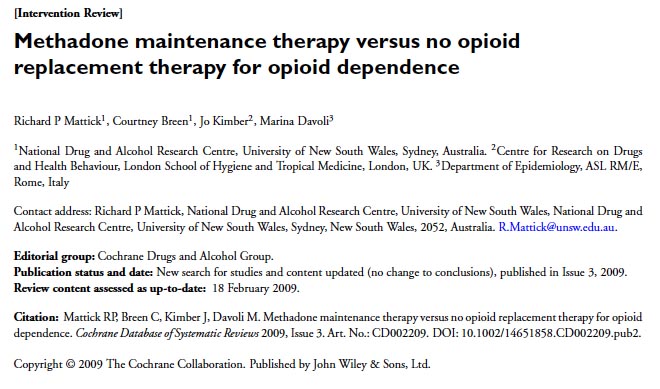
Mattick JP et al. Methaodone. 2009 title

Many controlled, clinical studies have examined the effectiveness of methadone. But a comprehensive comparison of methadone versus control, non-medication based treatments has not been considered amongst the various studies.

Researchers at the Cochrane Library performed this type of comprehensive analysis. Data was considered from 14 unique, previous clinical studies conducted over the past 40 years. Researchers compared methadone treatment versus control, non-medication based treatment approaches (placebo medication, withdrawal or detoxification, drug-free rehabilitation clinics, no treatment, or waitlist).

11 studies and 1,969 subjects were included in their final analysis.

 Read the full paper, published in 2009, here.

The results were clear. Methadone was found to keep people off of heroin and in treatment more effectively than control treatments. Urine analysis confirmed methadone-treated addicts were more likely to be heroin-free and regularly seeking treatment.

Of course, as I stated above, this is nothing new. But it’s important to note that abstinence therapies or treatments that encourage addicts to go “cold turkey” don’t really work; inevitably, relapse will occur. A medical treatment exists to help addicts fight their cravings so their brains are not fixated on obtaining heroin and these people are able to regain normal daily functions. And in time, methadone doses can be tapered down as intensity and frequency of cravings decrease.

The debate now should not be on whether methadone works, but on how to use it effectively and how to expand its use so that as many people as possible can benefit from it.

Most importantly, methadone helps an addict to return to normal life. End of story.

Childhood Abuse Has Long-lasting Effects on Brain Function

(© Derek Simon 2015)

(© Derek Simon 2015)


Why is it that one person becomes an addict and another does not?

This is a central question in addiction field and one that I’ve touched on in some of my posts (and will continue to explore in the future). Two recent papers may help to shed more light on this difficult and complicated question. Both studies have revealed changes that occur in the brain as a result of childhood trauma that may cause an individual to be more susceptible to risky behavior such as drug abuse.

Both papers are neuroimaging studies meaning they use living human subjects and look at brain activity in response to different scenarios. There are many ways to image a living brain but these studies both use functional magnetic resonance imaging (fMRI). Basically, fMRI measures blood flow into the brain. As neurons turn “on” (that is, when they conduct an electrical signal), they require energy. Neurons use glucose as their primary energy source, which is delivered to them through blood flow. Therefore, the more blood flowing to a region of the brain = the more energy required by neurons = more neurons “firing”.

 The analysis of fMRI data is very complicated and beyond the scope of my knowledge or this discussion. But in essence, when you think or read about something, certain areas of your brain process that information. Using fMRI, you can actually visualize regions of the brain that are turning “on” or “off” when a patient thinks about a particular situation! Watch these YouTube videos for additional explanations on fMRI.


fMRI Image (wikipedia.org)

fMRI Image (wikipedia.org)

In both of the studies featured in today’s post, subjects would read different scripts while in the fMRI scanner and the scientists would image the entire brain and identify the regions that were active during the test. Then data from multiple subjects can be compiled and a composite image that represents the averages all the subjects can be produced. The picture to the right is an example of this type of composite image. Finally, you can see which regions of the brain are active for most of the patients during the different experiments. Keep this information in mind as I go over the papers.

Elsey et al. Neuropsychopharm. 2015

The first paper performed fMRI scans on adolescents that had or had not experienced maltreatment or trauma during childhood (less than 18 years old). 67 subjects were recruited from a larger study looking at disadvantaged youth and 64 were eventually used in the study. The adolescents filled out a standard survey that allowed the scientists to learn which of the subjects had experienced maltreatment/trauma during childhood.

The experiment involved having the different subjects read a script about either a stressful moment, their favorite food, or something neutral or relaxing while their brains were being imaged in the fMRI scanner.

Amazingly, for the stressful scenario, a difference in brain activity was detected in multiple regions of the prefrontal cortex only in subjects that had experienced childhood maltreatment! What this means is those youths that were abused as kids responded to stress differently than youths that were not abused. Their brain function has literally been changed later in life as a result of the abuse they suffered as children.

 The prefrontal cortex is a part of the mesocorticolimbic system, a group of brain areas especially involved in addiction. The prefrontal cortex is also involved in decision making, impulsivity, and other functions. It’s not clear what this change in prefrontal cortex activity actually means but it is possible that the altered activity could make the youth more vulnerable to stress or more likely to engage in risky activities, such as drug abuse.

 Elton et al. Addiction Biol. 2014

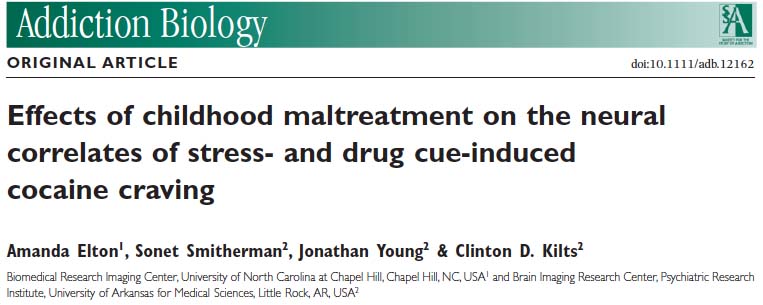
The second study was also interested in subjects that had experienced maltreatment or trauma during childhood but it instead of adolescents, this study used subjects that are adult men dependent on cocaine. Similarly, the subjects were grouped into those that had been mistreated as kids and those that had not.

In a parallel design to the other study, the subjects read a script describing a situation while being scanned in the fMRI machine. The scripts in this study included stress, cocaine-associated, and neutral. Interestingly, an increase in activity in a specific region of the prefrontal cortex and an area of the brain involved in motor activity were detected in the subjects that had been abused during childhood. And even more important, these changes were correlated to enhanced drug craving. These results suggest that childhood trauma can affect drug craving for addicts, which may be relevant factor in triggering relapse. That is to say, addicts that have been abused as children may be more vulnerable to not only acquiring addiction but also relapse.

 It is important to keep in mind that, like the previous study, the real functional importance of these different changes in unknown. However, clearly there are real changes that occur in the brain as a result of abuse/maltreatment during childhood. Imaging data must be taken with a grain of salt because it is difficult to show real causality. Yet, both studies (and many others) suggest long-lasting changes in brain activity, especially in response to stress, as a result of childhood trauma/maltreatment.

The conclusions we can draw from these studies is that childhood mistreatment, or trauma can have lasting changes on the brain. How these changes affect behavior is a much more difficult question to answer. Nevertheless, the changes that occur may be one of the factors that can contribute to susceptibility to addiction. These studies are supported by a previous post in which animal studies have shown that stress during early age leads to greater drug use as an adult.

And a broader point, these two neuroimaging studies help to put a different perspective on disadvantaged youth and importance of a stable home life, the lack of which can significantly affect you as an adult and may even contribute to susceptibility of become a drug addict.

New York City’s Failure to Care for Recovering Addicts

(From wikipedia.com)

(From wikipedia.com)

A new investigative report in the New York Times reveals a corrupt and virtually unregulated system of housing that preys on those that suffer from addiction and mental disease. Called “three-quarter” homes, there may be as many as 600 of these privately owned residences in NYC that act as a limbo between inpatient hospital care and shelters. The article tells the story of a group of homes owned by a single landlord and a few of the unfortunate residents trapped within this system. Disturbingly, reputable hospitals and treatment centers often refer patients to these homes. Landlord’s profit off of their tenant’s state-provided subsidies, which are insufficient for any other type of housing. The landlord collects the government assistance checks provided to the tenants provided that they regularly attend treatment centers. This has the unexpected consequence of incentivizing a landlord to encourage his tenants to relapse and thus remain in treatment…and in the three-quarter home. This vicious cycle is perfectly encapsulated in the articles headline “A Choice for Recovering Addicts: Relapse of Homelessness.” Read the full article for more details.

However, the article neglects the opportunity to elucidate the root cause of the existence of these three-quarter homes: lack of a sufficient, standardized and coordinated health care system for the treatment of addiction and other mental diseases. A critical problem in the American healthcare system is the lack of adequate inpatient medical treatment for people suffering from addiction, and is why people get referred to the three-quarter homes in the first place.

Addiction is a complex mental health disorder that requires an individual treatment plan that may involve medication, counseling, group and/or individual therapy, and other options. Without a well-funded, evidence-based, medical treatment program formulated for an individual’s addiction, they are likely to fall into the purgatory of three-quarter homes or even worse, the streets or prison. Ultimately homes likes these are allowed to exist due to the lack of adequate treatment options and facilities for addicts.

 And of course, the medical and treatment culture of addiction cannot be changed until the stigma against addicts and addiction is changed. Addiction is a medical disease and needs to be treated as such.


Under Reporting of Deaths from Heroin Overdose

“If you don’t know how many people are dying from it, how do you know how to combat it?”

 This question, posed by Stacy Emminger, a woman her lost her son to heroin overdose, is at the heart of an article reported on NPR today.

Many states do not maintain accurate, detailed records of deaths due to overdose. As was the case for Emminger’s son, the death certificate states the cause of death as “multiple drug toxicity, accidental”. The problem with such a vague statement is that you have no idea what the person actually died from. This prevents identification of the full scope of the heroin (or other drug) problem and makes the availability of antidotes for overdose (like naloxone) or treatments (like methadone or buprenorphine) that much more difficult.

Read the whole article on NPR:

http://www.npr.org/2015/05/21/405936768/states-lack-accurate-statistics-on-widespread-heroin-use

Or listen to the story:

http://www.npr.org/player/embed/405936768/408407236

Optogenetics in the New Yorker

Optogenetics1Excellent new article on optogenetics in The New Yorker. Optogenetics is a powerful, cutting-edge tool developed by Karl Deisseroth’s lab (profiled in the article) and is one of most significant advances in neuroscience research in decades. I recently spent two months learning the technique and we will be implementing it in the lab I work in at Rockefeller University. Optogenetics allows researchers to turn specific neurons “on” and “off” and see how those neurons are directly involved in a particular behavior. The article does a great job of profiling Deisseroth himself and explaining a little bit of the history of optogenetics and other developments in the Deisseroth lab. Enjoy!

http://www.newyorker.com/magazine/2015/05/18/lighting-the-brain


The Scientist’s Toolbox: Techniques in Addiction Research, Part 2

Lab Mice IMG_4102

When a news article starts with the headline “A new study finds…” do you know what that means? The article is (allegedly) referring to a peer-reviewed scientific research paper. Research papers are the heart of the scientific research field and are a report of a series of experiments conducted by a scientist or team of scientists. In a future post, I’ll do a break down what a paper looks like but for now all you need to know is that the heart of the paper is the data. The data are the pieces of information that scientists have acquired from their experiments and are reporting in the scientific paper.

But how do scientists generate data?

This is one of the crucial questions in the scientific field because it refers to experimental design: 1) what is the question the scientists wishes to answer, 2) which experiments does the scientist need to design in order to answer those questions and 3) what are the different techniques and tools needed in those experiments?

This is my second post in series of posts I’m doing to show how scientists actually collect data and the various experimental techniques and tools we have at our disposal. Right now I’m only talking about neuroscience and techniques specific to the addiction field but may discuss more general biological tools and experimental techniques in the future.

In my last post in this series, I discussed the locomotor activity test (also known as the open field test), intravenous self-administration, and microdialysis. Today, I’ll discuss a behavioral technique that’s an alternative to self-administration: conditioned place preference.

 Conditioned Place Preference

Recall our discussion on self-administration. It’s a powerful technique that allows animals to administer drugs to themselves. The technique also has the potential to model initiation of drug taking, maintenance/escalation in drug taking, and even relapse-like behaviors. However, there is one major flaw with this technique. It is extremely difficult and very time consuming! After all, a mouse jugular vein is really small, which makes doing the surgeries not a trivial exercise…

Is there an easier way to study addiction that doesn’t require surgery? Thankfully, there is! Conditioned place preference (CPP) is another model to test whether animals find a drug of abuse pleasurable/rewarding or not pleasurable/aversive.

The technique is based on a Pavlovian or classical conditioning mechanism. Perhaps you’ve heard of the famous Russian scientist Ivan Pavlov? In a series of very famous experiments, he was able to cause dogs to salivate anytime he rang a bell (or any neutral stimulus for that matter). Like most famous discoveries, he wasn’t trying to do this but through careful observations he uncovered one of the basic mechanisms that underlies learning.

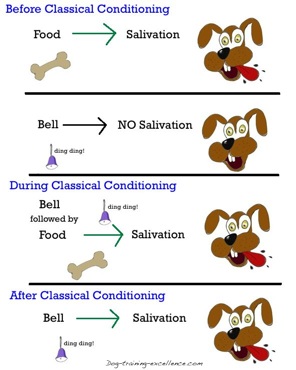
Pavlov’s conditioning experiment was done by presenting the dogs with an unconditioned stimulus, that is to say something that will cause a response in the animal no matter what, which is called an unconditioned response. In Pavlov’s case, he would present the dog with the unconditioned stimulus of food, which would cause the unconditioned response of salivating (Figure 1). Through careful observation, he was able to identify that dogs would salivate even before he put the food in front of them, sometimes just the site of the food dish was enough to cause the dogs to salivate. He followed up on this intriguing observation.

While the food is the unconditioned stimulus, the food dish or scientist bringing the food served as a neutral stimulus that normally would have no effect on the dogs ability to salivate. Pavlov tested if he could induce this salivating effect with other neutral stimuli. A neutral stimulus that normally has no effect on the animal, called a conditioned stimulus, would become associated with the unconditioned stimulus to produce a response (the conditioned response). In Pavlov’s experiments, the conditioned stimulus (food), when paired with the unconditioned stimulus (bell), would then produce a conditioned response (salivating).

Now let’s see how Pavlov’s conditioning experiment was actually done. If he rang the bell before the conditioning (the conditioned stimulus), it would have no effect. The dogs don’t really care about the noise from the bell because it is not associated with anything in the dog’s brains. But every time the food (unconditioned stimulus) is presented to the dogs, Pavlov would ring the bell (conditioned stimulus). Now the ringing of the bell became associated in the dog’s brain with the presence of the food.

Finally, after the conditioning sessions, Pavlov would ring the bell and would remarkably cause the dogs to salivate (conditioned stimulus)! They had learned to associate the sound of the bell with the presence of the food. Just to clarify, the dogs are not “choosing” to associate the bell with food. This type of conditioning is hard wired into the brain itself—forming these type of associations is one of the things that brain does best. In fact, classical conditioning is a basic mechanism in many types of learning. To this day, Pavlov’s work remains some of the foundational experiments in the biological basis of learning.

Here’s a video I found on YouTube that summarizes everything that you just read:


The taking of a psychoactive drug can actually have a similar type of classical conditioning effect. Think about it this way, a drug is never taken in a vacuum,it is always taken in a particular context. A drug may be frequently taken in a particular location, or under particular circumstances, or even with certain people.

I’m a former cigarette smoker and this is an example of conditioning that I personally experienced. Every time I got in the car I would light up a cigarette. After months and years of smoking, I caused a classical condition effect in myself. The cigarette (unconditioned stimulus) produces that “nicotine high” and relaxing feeling that smokers crave (unconditioned response). However, driving in a car (conditioned stimulu) normally does not cause that feeling. But every time I would need to drive someplace I would smoke. Eventually, simply being in the car would cause a craving for a cigarette! The conditioned stimulus of driving became associated with the unconditioned stimulus of smoking to produce the conditioned response of nicotine craving every time I go into the car.

Classical conditioning is exactly how conditioned place preference works. In the laboratory, we can use this basic mechanism to force mice to experience a conditioned response when placed in a distinctive chamber. The mouse will even seek out that chamber and spend time in it because they know that they received a “good feeling” anytime they were in the chamber before.

This is what the chamber looks like.

CPP Chamber (© Derek Simon 2014)

CPP Apparatus (© Derek Simon 2015)

It consists of three connected boxes: a central grey one with normal flooring, a white-walled one on the left with a mesh grating as the floor, and a black-walled one on the right with steel bars on the floor. There are special trap doors (white knobs in the picture below) that can be opened or closed so that a mouse is allowed to either explore the whole apparatus or be confined to one of the chambers. When the mouse is being conditioned, the trap doors are closed and the mouse stays in only one chamber the whole time.

CPP Apparatus (© Derek Simon 2014)

CPP Apparatus (© Derek Simon 2015)

A CPP experiment consists of four main steps: 1) the pre-test day, 2) the conditioning sessions (multiple of these), 3) the post-test day, and 4) data analysis. (See Figure 2 below).

Step 1: A mouse in placed in the central grey chamber and it is allowed to explore the entire apparatus all it wants want. Both the white and black chambers represent a conditioned stimulus because right now, they have no association with anything in the mouse’s brain. The time spent in each chamber is recorded.

Step 2: Now the mouse receives an injection of drug (or saline as a control substance) and then is placed in either the white or black chamber. The mouse is forced to stay in the chamber for the entire session (usually 15-30min). That way the features of the chamber (wall color and floor texture) become associated the unconditioned stimulus of the drug. One conditioning session occurs a day for several days.

Step 3: The test day. Now the trap doors are raised and the animal is allowed to explore all three chambers again. If the experiment worked, the mouse will spend most of its time in the chamber that it received the drug injections! In other words, the mouse was conditioned to expect the drug in either the white or black chamber and, given the choice, prefers to spend time in that chamber in anticipation of the drug.

Step 4: Analysis. The time spent in the drug or saline-paired chamber on the test day is subtracted from the time spent in that chamber on the pre-test day. This difference in time is considered the quantitative measure of a successful conditioning session.

This figure summarizes a CPP experiment:

Figure 2: Diagram of a CPP Experiment (© Derek Simon 2015)

Figure 2: Diagram of a CPP Experiment (© Derek Simon 2015)

If an animal likes a drug and finds it pleasurable and rewarding, it will spend a lot of time in the conditioning chamber (see the graph). If the mouse hates the drug, it will not spend time in the conditioning chamber. By using this setup, we can test how different drugs and doses of drugs, and other types of experimental manipulations can effect how a the mouse perceives the drug.

If we were to compare self-administration to CPP, a conditioned response in the CPP experiment would be a similar measure as self-administration of a drug. Both experiments reveal that the animal likes the drug and wants to take it.

And as with self-administration, many variations on the basic setup exist but I’ll spare you those details for now…

Thanks for reading!

New Study-Treatment of Opioid Addicts in Prison and Effect on Relapse After Release

JD Lee et al. 2015. Title

There are many stigmas about addiction that are prevalent in society but the underlying cause of them all is that addiction is moral failing, even though we know addiction is a biological disease of the brain (with behavioral symptoms). In addition to being scientifically unfounded, stigmas about addiction can actually affect policy and public health decisions that have a real impact on people’s lives. In the perfect world, every decision we made would be based on concrete evidence and controlled, experimental studies. Unfortunately, this seems to be the exact opposite case for our attitudes as a society and our public policy towards drugs—ignorance, assumptions, and misconceptions seem to dominate. Nevertheless, as scientists, all we can do is the best work we can, explain and communicate the science to as many people as possible, and help to promote and support the work of others. Which brings me to today’s paper: a small pilot study that may have a wide impact on the treatment of addicts in the criminal justice system.

The paper, released in the journal Addiction, looks at how treatment for opioid addiction while in prison can affect the rate of relapse to opioid abuse once inmates are released. The study recruited opioid-dependent male inmates incarcerated in New York City jails that were not interested in maintenance therapy (methadone or buprenorphine). The treatment tested is a new medication, an extended-release naltrexone (XR-NTX), a compound that blocks opioid receptors.

Note on pharmacology: naltrexone is what’s known as a mu opioid receptor (MOPR) antagonist, meaning it blocks activity at MOPR (the molecular target of opioid drugs). It also has a weaker antagonist effect on kappa opioid receptors (KOPR). The KOPR plays a more complicated role in addiction, but several studies have suggested blockade of KOPR may reduce relapse. Extended release means that these receptors remain blocked for a sustained period of time after receiving the initial dose.

While 152 inmates were initially interviewed, only 34 fit the criteria for the study. Many subjects were excluded from the study for a variety of reasons that would have made the study difficult to perform or the data difficult to interpret. For example, no interest, currently on methadone or buprenorphine, tested positive for opioid prior to treatment, and other reasons.

The 34 subjects were randomly assigned to either the group that would receive the XR-NTX or standard behavioral therapy (i.e. no medication given to the patient). 15 (2 of the 17 refused) patients received a single injection of XR-NTX prior to release (average of 5 days before release) and 17 received no medication. Patients that received the XR-NTX were offered a second injection 4-weeks post release and 12 accepted this second injection.

6 of the 16 (1 remained incarcerated so was excluded) that received the first dose of XR-NTX had relapsed to opioid use at 1-4 weeks post-release while 15 of 17 relapsed for the control group. Urine analysis confirmed whether or a not a subject was on opioids.

Granted that these are very small numbers (the authors described the study as a proof-of-principle pilot study) but the data are statistically significant. This means that the effect the experimenters are observing is most likely real and not due to random chance. The results suggest that inmates that receive the XR-NTX medication are less likely to relapse after being released from prison.

 These results are important because one of the problems of the US criminal justice system is that addicts are not treated while in prison. While they are abstinent while incarcerated, the underlying neurobiology of their addiction is not being treated which results in almost immediate relapse following release from prison. This of course can result in being thrown back into jail 1) if arrested while using the drug or  2) due to criminal activity to support the addiction. This cycle of addiction-arrest-incarceration-relapse-arrest-incarceration is harmful for the criminal justice system, for the addicts themselves, and for society at large (after all, we are paying for it). This study suggests addicts in prisons that are treated with medication are less likely to relapse.

However, this study is extremely limited and needs to be expanded to a much larger group of inmates before any type of changes can be implemented on a large scale. Furthermore, once released, subjects need to be monitored more closely and for a longer period of time to determine if relapse rate remains low. Other medications prior to release, besides XR-NTX, should also be considered in future analyses.

Most importantly, this study is an example of how treating addiction as a medical disease that requires medical treatments can actually help addicts to stay off of drugs, and hopefully, out of prison.


Paper Review-Initiation into Injection Drug Use and Prescription Opioids

Lankenau SE, 2012

It’s been a few weeks since my last post. Apologies! Just finished up a big experiment and grant proposal. My goal is to release a few small posts over the next few days and here’s the first:

Numerous reported the dramatic increase in opioid addiction and death’s due to overdose over the past decade. Abuse of prescription opioid pain medication, such as oxycodone and hydrocodone, has skyrocketed. Even more disturbing is the surge in addiction to heroin, which was in decline during the 80s and 90s. I already reviewed an article that cites some of the statistics. Read it here.

Some key facts cited in today’s paper:

  • Abuse of prescription opioid drugs has been increasing dramatically over the past decade, especially amongst young people (18-26)
  • Opioids, such as hydrocodone and oxycodone, are the second most abused drug amongst young adults, after cannabis.
  • Very little data exists on initiation of drug abuse (i.e. first drugs abused) among injection drug users.

This study is a epidemiology/public health study that recruited 50 young (under 30), active injection drug users (e.g. heroin users) from New York and Los Angeles and interviewed them about their drug use. Note that this is a small study as far as epidemiology studies go, and the authors admit this and describe it as an exploratory study, but the trends they find are consistent with other studies (see the National Survey on Drug Use and Health).

The conclusions are simple: the majority of injection drug users began by abusing prescription opioids.

The average age for first use of prescription opioids was 12.6 years old and 41/50 reported swallowing (compared to 8 that snorted or 1 injecting). And 30/50 reported getting the prescription opioids from the homes of either immediate or extended family members that had a prescription.

Even more disturbing is that 36/50 injection drug users reported having a prescription for opioid pain medications during their lifetime, which occurred on average at 14.6 years of age. 8 of these 36 reported their opioid abuse began from their own prescriptions.

Several other interesting trends can be found in this study but the conclusions are pretty stark: injection of heroin began with abuse of pain pills.

Clearly tighter control of available prescriptions and careful monitoring of prescription opioids is required to help control their abuse among adolescents. However, the specific policy recommendations and medical attitude changes necessary are complex. Hopefully the more knowledge about the topic will provide an impetus for this important and necessary discussion.